

Stackable Plastic Chairs vs Folding Plastic Chairs: Which Should You Buy?
Share
Walk into any Indian home preparing for a festival, any event manager's warehouse ahead of a wedding season, or any school preparing for a prize day, and you will find one of two things: a pile of stacking chairs or a row of folding chairs. Both solve the same fundamental problem - seating more people than the space normally accommodates, then making that seating disappear when it is not needed. But they solve it differently, and the difference matters more than most buyers realise at the point of purchase.
This is a direct comparison. Stackable plastic chairs and folding plastic chairs each have specific strengths, specific weaknesses, and specific settings where one is clearly the better choice. By the end of this guide, you will know exactly which one belongs in your home, your venue, or your business - and why.
What Is the Actual Difference Between a Stackable Chair and a Folding Chair?
A stackable chair is a full-sized, rigid chair with four fixed legs that is designed so that identical chairs can be placed on top of each other vertically. The chair's legs and seat geometry allow each unit to rest securely on the one below it. When in use, a stacking chair sits, looks, and behaves exactly like a standard chair - it has no mechanical parts, no moving joints, and no frame components that separate from the seat.
A folding chair is a chair with a collapsible mechanism - typically a hinged metal or plastic frame - that allows the entire chair to fold flat when not in use. The seat and backrest pivot inward toward each other and the legs collapse, reducing the chair to a flat package typically 5 to 8 cm thick. When in use, a folding chair must have its mechanism locked open for safety before use.
This structural difference determines almost everything that follows - durability, comfort, storage efficiency, safety, and total cost of ownership over time.
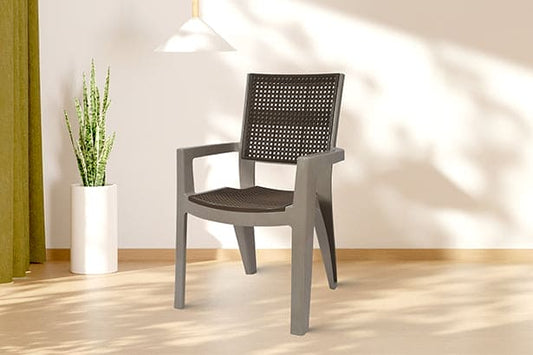
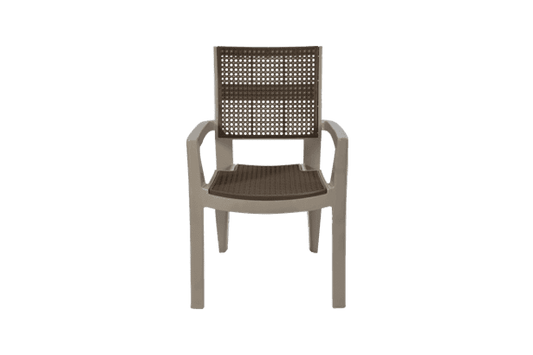
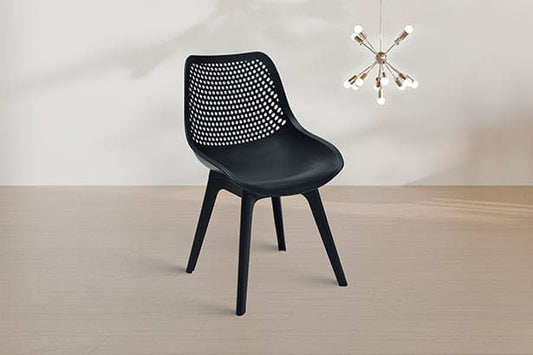
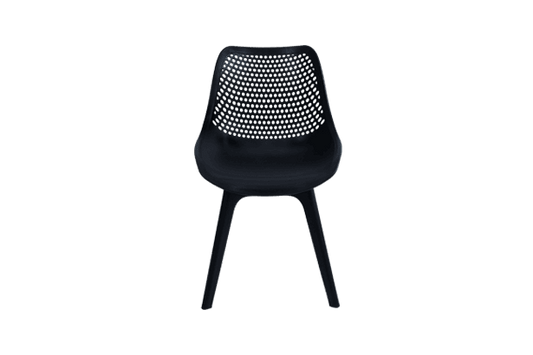
Italica's Phoenix Folding Chair is the brand's flagship folding product, engineered with a reinforced hinge mechanism and full-polypropylene seat and backrest. Italica's Oxy Series, Cafe Series, and Designer Series are the primary stackable ranges, designed to stack six to eight units cleanly without surface marking.
How Do Stackable and Folding Chairs Compare on Storage Efficiency?
Storage is the primary reason most Indian buyers consider either format - so it is the right place to start.
How efficiently does each chair type store?
A stackable chair reduces to its own footprint when stacked. A set of eight Italica Oxy Series chairs stacked together occupies approximately the floor space of a single chair - roughly 55 cm × 55 cm - and reaches a height of approximately 120 to 140 cm. That stack of eight seats fits comfortably in a standard Indian cupboard, a corner of a room, or against a wall behind a door.
A folding chair collapses to a flat profile of approximately 5 to 8 cm in thickness, 45 to 50 cm in width, and 85 to 95 cm in height. Multiple folding chairs can be leaned vertically against a wall in a rack or stored flat in a horizontal stack. Ten folding chairs stored vertically against a wall occupy a wall strip of approximately 50 to 80 cm width, depending on whether a rack is used.
The honest storage comparison: both formats are highly space-efficient compared to fixed rigid chairs. For very tight storage spaces - a narrow cupboard, a wall-mounted rack, under a bed, or inside a vehicle - folding chairs win on storage depth because they collapse to a single flat panel. For floor-standing storage in a room corner, cupboard, or verandah space, stackable chairs win because they require no rack, no wall attachment, and no laying-flat process - you simply place one on top of another.
|
Storage scenario |
Better choice |
|
Narrow cupboard or wall rack |
Folding chairs |
|
Room corner or against a wall, free-standing |
Stackable chairs |
|
Vehicle boot for transport to a venue |
Folding chairs (flat stacking) |
|
Storeroom or warehouse racking |
Stackable chairs (vertical stacks, no rack needed) |
|
Apartment balcony or verandah corner |
Stackable chairs |
|
Under-bed or under-staircase storage |
Folding chairs |
Which Is More Durable: a Stackable Chair or a Folding Chair?
Durability is the dimension where the structural difference between the two formats has the most direct consequence.
A stackable plastic chair has no moving parts. The entire chair is a single-piece or two-piece injection-moulded polypropylene structure - seat, backrest, and legs - with no hinges, pins, or mechanical joints. There is nothing to corrode, seize, snap at a hinge point, or wear through repeated use cycles. The failure modes are limited to material stress fractures under overloading or UV degradation without UV stabilisation. A premium stackable chair from a quality manufacturer will simply not develop mechanical failure regardless of how many times it is stacked, unstacked, moved, and sat in.
A folding chair has a hinge mechanism - the mechanical joint that allows the chair to open and close. This mechanism is the most vulnerable point in the product's structure, and it is where folding chairs most commonly fail. The hinge pin and locking mechanism are subject to metal fatigue, corrosion in humid Indian conditions, and wear from repeated open-close cycles. In a household that deploys folding chairs a few times a year, the mechanism may last the chair's full lifetime without issue. In a commercial venue or event hire business deploying folding chairs hundreds of times a year, hinge mechanism failure within three to five years is a realistic expectation for standard-quality products.
Additionally, the frame of most folding plastic chairs includes metal components - the scissor-action legs are typically steel tube covered with polypropylene or bare metal. Metal components in Indian humidity and coastal environments are susceptible to surface rust, which weakens the frame over time and creates staining on storage surfaces.
Italica's Phoenix Folding Chair uses a reinforced hinge design that significantly extends mechanism life compared to standard folding chair construction. But the fundamental mechanical vulnerability remains - and for buyers who prioritise a single, long-lasting chair over a decade or more of daily or high-frequency use, the mechanically simpler stackable design has a structural durability advantage.
For buyers in high-use commercial and institutional settings - event venues, schools, religious institutions - <cite index="8-1">stacking chairs generally have a longer lifespan than folding chairs</cite>, particularly when made from durable materials with consistent-thickness moulding.
Which Is More Comfortable for Extended Sitting?
Comfort is the dimension most buyers think about last when comparing stackable and folding chairs - usually because both formats are associated with short-duration occasional use. But the difference in sitting comfort between the two formats is real and matters in practice.
A stackable plastic chair is, structurally, a standard chair - it has a fixed seat pan, a fixed backrest in a consistent angle relative to the seat, and four legs providing a stable base. The comfort profile of a stacking chair is determined entirely by its design - seat contour, backrest height, backrest angle, and lumbar support geometry. A well-designed stacking chair such as Italica's Oxy Series or Cafe Series delivers the same back support and sitting comfort as any equivalent non-stacking chair. The stacking feature adds nothing to comfort and removes nothing from it.
A folding chair's comfort is inherently compromised by its mechanism. The hinged frame means the seat and backrest must be designed around the folding geometry - the angle between the seat and backrest is determined partly by what allows the chair to fold flat rather than purely by ergonomic principles. The result is that folding chairs typically have a more upright backrest angle and a less contoured seat than equivalent non-folding chairs. For short-duration use - a two-hour event, a festival meal - this makes little practical difference. For sitting periods of more than two hours, the ergonomic limitations of a folding chair's geometry become perceptible.
In practice, folding chairs are designed for temporary, event-style use where comfort over extended periods is secondary to portability and compact storage. Stackable chairs are designed for regular use - as dining chairs, café chairs, or household seating that happens to store efficiently - and their comfort standards reflect this.
Which Is Easier to Transport and Deploy?
This is where folding chairs hold their strongest practical advantage, and it is the reason event managers, caterers, and mobile service businesses almost universally choose folding chairs over stackable ones.
A folding chair collapsed to its flat position can be carried under one arm, placed in a bag, or stacked flat in a car boot or tempo van with minimal wasted space. A person can carry four to six folded chairs in each hand simultaneously using built-in carry handles. This makes rapid deployment and recovery of large quantities of chairs by a small team practical in a way that is impossible with stackable chairs.
A stackable chair, while lighter than it looks, cannot be carried in the same flat configuration. Stacks of stackable chairs require a trolley for moving more than four or five units at a time. In a venue with multiple rooms, multiple floors, or where chairs move between indoor and outdoor settings during an event, the transport handling difference between formats becomes operationally significant.
For a household buyer setting up for a festival or family occasion - moving a stack of six or eight chairs from a storeroom to a dining area once or twice a year - the transport difference is negligible. For an event business deploying 200 chairs across a venue multiple times per week, folding chairs are operationally superior for transport and rapid turnaround.
What Are the Real Use Cases for Each Format in the Indian Context?
When should you buy stackable chairs?
Household supplementary seating. For Indian homes where six to ten extra chairs are needed for festivals, weddings, and family occasions and stored the rest of the year, stackable chairs are the better choice. They provide genuine sitting comfort for the three to five hours of a family meal or puja, store neatly in a corner without special equipment, and double as regular dining or kitchen chairs that happen to stack away efficiently when not in use.
Restaurants, cafes, and food service. Every restaurant and café that sets up outdoors, reconfigures its space, or stores chairs between service periods uses stackable chairs. Italica's Cafe Series was designed specifically for this context - chairs that stack cleanly without surface marking, handle daily heavy use, and clean in seconds between seatings.
Schools and educational institutions. Classrooms, assembly halls, and examination centres use stackable chairs because they need to reconfigure space frequently and store chairs efficiently between sessions. The absence of mechanical parts also means lower maintenance cost in institutional settings.
Hotel and resort supplementary seating. Stackable outdoor chairs for pool decks, terrace restaurants, and event lawn areas are the standard format in Indian hospitality because they handle daily repositioning, high-frequency stacking, and cleaning demands without mechanical vulnerability.
Long-duration events where comfort matters. Weddings, corporate events, and religious functions lasting several hours benefit from the better sitting comfort of stackable chairs over folding chairs for the same reason dining chairs outperform folding chairs over a long meal.
When should you buy folding chairs?
Mobile event and catering businesses. If you set up chairs at different locations - outdoor catering, pandal seating, exhibition stalls, or roadshow events - folding chairs' transport efficiency is a decisive advantage. Loading 100 folding chairs into a vehicle is significantly more compact and faster than 100 stacking chairs on trolleys.
Homes with very limited storage. For an apartment where storage space is genuinely restricted - no storeroom, a small cupboard - folding chairs that can be hung on wall hooks or stored flat under a bed may be the only practical option. Italica's Phoenix Folding Chair accommodates exactly this storage scenario.
Short-duration temporary seating. For settings where chairs are in use for one to two hours and then need to disappear immediately - an office presentation space, a small meeting room, a classroom where chairs are brought in for a guest lecture - the rapid flat-collapse storage of folding chairs is their defining advantage.
Transportation and field use. For buyers who need chairs that travel in a vehicle - field offices, election booths, outdoor medical camps, rural event deployments - folding chairs are the appropriate format. They load efficiently, do not shift in transit, and require no special handling equipment.
Side-by-Side Comparison: Stackable vs Folding Plastic Chairs
|
Feature |
Stackable plastic chairs |
Folding plastic chairs |
|
Storage method |
Vertical stacks, no equipment needed |
Flat collapse, wall racks or flat storage |
|
Storage for 10 chairs |
Single corner stack ~55 × 55 × 170 cm |
10 flat panels, ~50 × 10 × 90 cm each |
|
Durability |
Excellent - no mechanical parts |
Good - hinge mechanism is vulnerability point |
|
Sitting comfort |
Full chair ergonomics, backrest support |
Limited by fold geometry |
|
Transport for large quantities |
Requires trolley - less portable |
Flat carry, 4–6 per arm, very portable |
|
Maintenance |
Wipe clean, no mechanism care |
Clean body + occasional hinge maintenance |
|
Suitable for daily regular use |
Yes - designed for frequent use |
Better for occasional/event use |
|
Suitable for mobile deployment |
Limited |
Excellent |
|
Metal components (rust risk) |
None (full polypropylene) |
Yes - frame is typically steel tube |
|
Typical lifespan (regular use) |
8–12 years |
5–8 years (depending on hinge quality) |
|
Best setting |
Home, restaurant, institution, hotel |
Event business, mobile, tight storage |
Can You Buy One Format That Does Both Jobs?
The most common question Indian buyers ask is whether one format can serve all purposes - and the honest answer is that it can, with trade-offs in each direction.
If you buy only stackable chairs and store them in a room corner, you gain durability, comfort, and clean aesthetics but lose the flat-collapse portability that makes folding chairs easy to transport in a vehicle.
If you buy only folding chairs, you gain transport flexibility and flat storage options but sacrifice some sitting comfort for long events and accept the ongoing risk of hinge mechanism wear in high-use situations.
For most Indian households, stackable chairs are the better single-format choice - they are more durable, more comfortable, and equally space-efficient in the household storage contexts where most families use them. Italica's Oxy Series or Cafe Series, stacked six to eight units, is the practical answer for 90 per cent of home supplementary seating requirements.
For event businesses, mobile caterers, and buyers who regularly transport chairs between locations, folding chairs are the correct primary format. Italica's Phoenix Folding Chair is designed specifically to handle this use case with a reinforced hinge and full-polypropylene seat and backrest construction that out-performs the bare-metal folding chairs common in the event hire market.
Some buyers in high-demand settings maintain both: a core set of stackable chairs for regular use and dining, and a smaller set of folding chairs for transport and space-emergency deployment. This combination covers every scenario without compromising on either durability or portability.
Conclusion
Stackable plastic chairs and folding plastic chairs are not interchangeable - they are two distinct design solutions for two distinct problems. Stackable chairs solve the problem of seating more people regularly while storing efficiently in a fixed location. Folding chairs solve the problem of transporting and deploying seating quickly across multiple locations with minimal equipment.
For Indian homes, restaurants, schools, and hotel properties where chairs are stored in place and used frequently, Italica's stackable ranges - Oxy Series, Cafe Series, and Designer Series - offer the durability, comfort, and storage efficiency that fixed-location high-frequency seating demands. For mobile event businesses, caterers, and buyers with very constrained flat-storage needs, Italica's Phoenix Folding Chair delivers the portability and rapid-deployment capability the format is built for.
Explore both ranges at italica.com to find the right format - or combination of formats - for your specific seating requirement.
Frequently Asked Questions
Q: What is the difference between stackable and folding plastic chairs?
A: Stackable plastic chairs are rigid, fixed chairs that stack vertically on top of each other for storage - they have no moving parts and behave exactly like standard chairs when in use. Folding plastic chairs have a hinged mechanism that allows the entire chair to collapse flat when not in use, making them compact for transport and wall-mounted storage. Stackable chairs are more durable and comfortable for regular use; folding chairs are more portable and suited to mobile deployment and event hire.
Q: Which lasts longer - a stackable or folding plastic chair?
A: Stackable plastic chairs generally last longer under regular high-frequency use because they have no mechanical parts that can wear, corrode, or fail. A premium stackable chair from virgin polypropylene has a typical household lifespan of 8 to 12 years. Folding chairs have a hinge mechanism that is subject to metal fatigue and corrosion in Indian humidity - in high-frequency deployment settings, hinge failure within 5 to 8 years is common for standard-quality folding chairs. For home and institutional use, stackable chairs are the more durable investment.
Q: How many stackable chairs can you stack safely?
A: Quality commercial stackable chairs are designed to stack 6 to 8 units for household and restaurant use. Institutional and event-grade stacking chairs from quality manufacturers can safely stack 15 to 20 units when using proper stacking trolleys. For home use without trolleys, Italica recommends stacking no more than 8 units to ensure stability and safe handling when retrieving chairs from the stack.
Q: Are folding chairs good for Indian weddings and events?
A: Folding chairs are well-suited for mobile event businesses that transport chairs between multiple venues, as their flat-collapse design loads efficiently into vehicles and deploys rapidly with a small team. For fixed-venue weddings - garden, banquet hall, or farmhouse - where chairs are stored on-site and comfort over a 4 to 6 hour event matters, stackable chairs offer better sitting comfort and are the more common choice among established Indian event venues. Many large-scale event operators use both formats for different seating zones.
Q: Which is better for a small Indian apartment - stackable or folding chairs?
A: For most Indian apartments, stackable chairs are the more practical choice. A stack of six to eight chairs in a room corner or behind a door occupies approximately the footprint of a single chair and requires no wall rack or special storage equipment. Folding chairs offer an advantage only in apartments where even corner floor space is not available - if chairs must be hung on wall hooks or stored flat under furniture, the folding format is the better option. Italica's compact stackable Oxy Series chairs are specifically well-suited to apartment supplementary seating given their slim stacked profile.