

Best Plastic Sunlounger for Pool and Terrace in India: Complete 2026 Guide
Share
There is a specific kind of afternoon that every Indian home with a pool or terrace is capable of delivering - unhurried, warm, completely still except for the sound of water or distant city noise. The right sunlounger is what makes that afternoon possible. The wrong one - one that creaks under weight, fades to chalky grey by August, or traps heat so intensely it becomes unusable past noon - makes you regret the purchase every time you walk past it.
India's outdoor living market is growing fast. India's outdoor living structure market is expected to record a CAGR of 8.1% between 2026 and 2036, driven by semi-urban and Tier 2 city demand and growth in holiday home ownership. Across Mumbai high-rises with rooftop terraces, Goa and Kerala villas with private pools, Bengaluru independent houses with garden decks, and resort properties across every major leisure corridor, the sunlounger has moved from a luxury purchase to a considered investment in everyday outdoor living.
This guide covers everything you need to choose the right plastic sunlounger for your pool, terrace, or outdoor space in India - what features matter, what to avoid, how to plan your space, and what makes Italica's sunlounger range specifically suited to Indian outdoor conditions.
What Is a Sunlounger and How Is It Different From a Regular Outdoor Chair?
A sunlounger - also called a deck chair, pool chaise, or reclining lounger - is a single-person reclining seat with an extended backrest and full leg support, designed for sustained relaxation in a reclined or semi-reclined position.
The key distinction from a regular outdoor chair is the full-body support profile. A standard outdoor chair supports your back and seat. A sunlounger supports your entire body from head to heel - you can read, nap, sunbathe, or simply rest in a reclined position for extended periods without postural discomfort.
The second key distinction is adjustability. A quality sunlounger offers multiple backrest positions - typically five to seven - allowing you to move between upright reading position, mid-recline for lounging, and fully flat for napping or sunbathing. This versatility is what makes a sunlounger the primary piece of furniture on any pool deck or sun terrace.
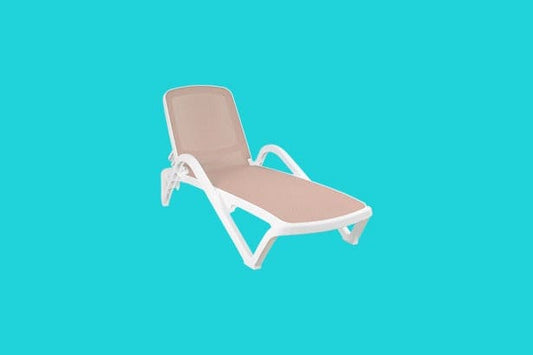
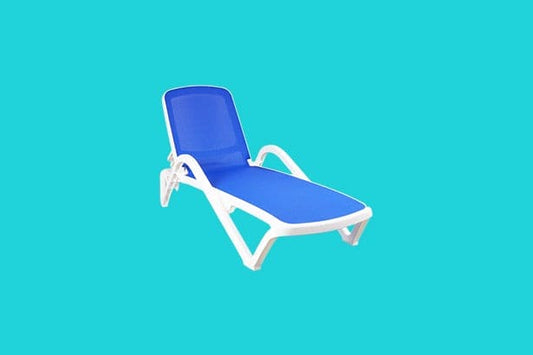
Italica's Sunlounger 8106 - the flagship piece in Italica's Pool and Beach Series - is built around both of these principles. It is a full-length reclining lounger with multiple backrest positions, wheeled feet for easy repositioning, and a construction specifically engineered for Indian poolside and terrace conditions.
What Are the Most Important Features to Look for in a Plastic Sunlounger in India?
Does the sunlounger have genuine UV stabilisation?
This is the single most important material specification for any outdoor product in India, and it is the feature that most clearly separates a sunlounger that will look good in five years from one that will be chalky, faded, and brittle by the second monsoon.
UV stabilisation means that UV-inhibiting compounds have been incorporated into the polypropylene resin during the moulding process - not applied as a surface coating afterward. Resin-incorporated UV stabilisers protect the entire depth of the material for the full product lifespan. Surface coatings degrade within one to two seasons of direct sun exposure in India's climate.
When evaluating any plastic sunlounger, ask the supplier specifically whether UV stabilisers are resin-incorporated or surface-applied. Italica uses resin-incorporated UV protection across its outdoor range, including the Sunlounger 8106, which is why its colour integrity holds across multiple Indian summer and monsoon cycles.
How many backrest positions does it offer?
Sunloungers with five to seven independent backrest positions offer the most versatile use - covering upright seating, reading recline, shallow lounge, deep lounge, and fully flat positions. Fewer than four positions limits the lounger's practical versatility. A quality adjustment mechanism should operate with one hand and lock securely at each position without slipping under bodyweight.
All adjustment hardware - the pins, notch mechanisms, and connecting brackets that hold the backrest at each position - must be stainless steel for poolside use. Standard zinc or galvanised steel hardware corrodes rapidly in chlorinated and coastal environments, jamming adjustment mechanisms and leaving rust marks on pool deck surfaces.
What load capacity should a sunlounger have?
For general residential and hospitality use, a sunlounger should be load-rated to a minimum of 120 kg. Properties catering to a wide guest demographic, or buyers wanting a long-term comfort margin, should look for 150 kg ratings. The load rating should be stated as a static test result - some manufacturers quote dynamic load ratings that are significantly less representative of real-world daily use.
Are wheels necessary on a pool or terrace sunlounger?
For pool decks, wheels are a significant practical feature rather than a convenience extra. A sunlounger is repositioned multiple times throughout a day - to follow the sun, to move into shade, to clear space for cleaning or events. Rear wheels that allow the lounger to be tilted and rolled make this effortless for a single person. Without wheels, moving a fully assembled sunlounger across a wet pool deck requires two people and risks surface scratching.
Italica's Sunlounger 8106 includes rear wheels as a standard feature - one of the practical details that makes it particularly well-suited to pool deck use in both residential and hospitality settings.
How important is drainage design in a sunlounger?
Extremely important in the Indian context. A sunlounger surface that retains water after rain or splashing is both a hygiene issue and a guest comfort issue. The seat and reclining surfaces of a quality poolside sunlounger should either be slatted - allowing water to drain freely between slats - or include deliberate drainage channels and apertures that prevent pooling.
For cushioned sunloungers, the cushion fabric must be a quick-dry outdoor textile - not standard upholstery fabric, which retains moisture and develops mould rapidly in India's humid conditions. Alternatively, a cushion-free polypropylene slatted or contoured surface requires no drying time at all and can be wiped clean in seconds.
Plastic vs Other Materials: Which Is Best for an Indian Pool or Terrace?
The material you choose determines your sunlounger's lifespan, maintenance burden, and long-term appearance in India's challenging outdoor environment. These are the most common options evaluated by Indian buyers.
|
Feature |
Premium plastic (PP) |
Aluminium |
Teak wood |
Rattan / wicker |
Cast iron |
|
UV resistance |
Excellent (if stabilised) |
Good |
Moderate (needs oiling) |
Poor |
Poor |
|
Chlorine resistance |
Excellent |
Good |
Moderate |
Poor |
Poor |
|
Salt air resistance |
Excellent |
Good |
Moderate |
Poor |
Very poor |
|
Monsoon performance |
Excellent |
Good |
Moderate |
Very poor |
Poor |
|
Weight (typical lounger) |
7–10 kg |
10–15 kg |
20–30 kg |
8–12 kg |
25–40 kg |
|
Maintenance requirement |
Very low |
Low |
High (annual oiling) |
High |
Very high |
|
Typical lifespan in India |
8–12 years |
8–12 years |
8–15 years* |
2–4 years |
5–8 years |
|
Repositioning ease |
Excellent |
Good |
Poor |
Moderate |
Very poor |
*Teak lifespan assumes annual maintenance. Without it, lifespan drops significantly.
For the specific combination of demands that Indian outdoor settings place on sunlounger furniture - sustained UV, monsoon rain and humidity, chlorinated pool environments in many properties, and the practical requirement for lightweight daily repositioning - premium UV-stabilised polypropylene delivers the most complete performance package. It outperforms aluminium on chlorine and salt resistance, dramatically outperforms teak and rattan on maintenance burden, and is the only material that combines genuine weather resistance with the lightweight handling that makes pool deck management practical.
Italica's choice of virgin polypropylene with UV stabilisers for the Sunlounger 8106 and the broader Pool and Beach Series reflects this material logic applied specifically to the Indian outdoor context.
How Do You Choose the Right Sunlounger Size for Your Pool or Terrace?
Space planning is where many Indian buyers make costly mistakes - either buying sunloungers too large for the available deck space, or underestimating how much clearance they need to actually use the lounger comfortably.
What is the standard sunlounger dimension?
A full-size sunlounger is typically 180–200 cm long when fully reclined and 60–70 cm wide. In the upright or mid-recline position, overall length shortens to 150–165 cm. When planning your deck or terrace layout, use the fully reclined dimension as your planning measurement - you will want the option to lie flat even if you primarily use the mid-recline position.
How much clearance does a sunlounger need?
Allow a minimum of 60–75 cm clearance between adjacent sunloungers for comfortable movement - to get on and off the lounger, to place items alongside it, and for housekeeping or cleaning access. For two sunloungers placed side by side, this means a combined footprint of approximately 180–205 cm in width.
Between the front edge of a sunlounger and any pool edge, wall, or other furniture, allow a minimum of 90 cm. This provides safe footing when getting off the lounger and adequate circulation space on a pool deck.
How many sunloungers fit on a typical Indian pool deck?
For a standard residential pool with a deck area of 20–30 square metres, two to four sunloungers is a typical configuration. For larger resort pools, the industry standard calculation is one sunlounger per 4 to 5 square meters of usable deck area.
If your terrace or deck has space for only two sunloungers, prioritise product quality and comfort - these will be used daily and should last a decade. If you are furnishing a larger space and cost per unit matters, Italica's commercial sunlounger range is available for bulk procurement with hospitality-grade specifications at institutional pricing.
What Is the Difference Between a Sunlounger for a Pool Deck and One for a Rooftop Terrace?
The use environment differs in several important ways, and the ideal sunlounger specification shifts accordingly.
Pool deck sunloungers are exposed to chlorinated water through direct splashing, wet guests, and poolside cleaning. Chlorine resistance is a mandatory specification. Drainage is critical - water pooling on seat surfaces is a hygiene issue in a pool environment. Wheels are highly useful given the frequency of repositioning. Dark colours absorb heat rapidly in poolside sun exposure and are generally less suitable - lighter shades and whites are the standard choice for pool deck furniture.
Terrace sunloungers are not typically exposed to chlorine but face sustained UV, rain, and - in coastal cities - salt air. Heat absorption is still a relevant consideration for terraces without shade structures. Aesthetics carry slightly more weight on a terrace that is visible from the home interior, making finish quality and colour choice a larger factor in the decision. On terrace surfaces, wheels are useful but furniture feet with floor-protection pads are important to avoid surface marking on tiles or finished stone.
Italica's Sunlounger 8106 is designed with specifications that work in both environments - UV-stabilised polypropylene, chlorine-resistant construction, rear wheels, and a finish quality appropriate for both poolside and terrace settings.
How Should You Care for a Plastic Sunlounger Through the Indian Summer and Monsoon?
A quality plastic sunlounger requires minimal maintenance - but a simple routine significantly extends its lifespan and appearance.
Daily care: Wipe down the seat surface after each use with a damp cloth. On a pool deck, a quick rinse and wipe removes chlorine residue and sunscreen that would otherwise build up and dull the surface over time.
Pre-summer preparation: Before peak summer (April–June), apply a UV-protective plastic spray or silicon-based polish to all plastic surfaces. This adds a protective layer against the intense UV radiation of Indian summer and reduces surface heating. Clean and inspect all adjustment mechanisms - lubricate stainless steel pins with a small amount of silicone spray to ensure smooth operation through the season.
Monsoon care: During heavy monsoon periods, orient sunloungers in their most compact position and store under cover where possible. If outdoor storage is unavoidable, use a weatherproof furniture cover and angle the lounger so water does not pool on the seat surface. Post-monsoon, clean all surfaces with a mild vinegar solution to remove any algae or mildew that developed during the humid season.
Off-season storage: In north Indian cities with a defined winter season, bringing sunloungers indoors or covering them for November to February protects the finish from cold-cycle stress and UV exposure during low-sun months when there is no functional use offsetting the environmental wear.
With this simple seasonal routine, a quality Italica plastic sunlounger in Indian conditions should maintain its appearance and structural integrity for eight to twelve years of daily use.
Who Should Buy a Plastic Sunlounger in India?
Homeowners with private pools or large terraces
The primary buyer. A private pool without sunloungers is functionally incomplete - the pool experience begins and ends at the water's edge, and good poolside seating is what extends it into an afternoon. For terrace owners, a sunlounger transforms a flat outdoor space into a genuine leisure zone regardless of whether a pool is present.
Holiday home and second home owners
Goa, Alibaug, Coorg, Lonavala, Kasauli, Ooty - India's holiday home belt is expanding. Second home owners need outdoor furniture that survives months of vacancy between visits and requires no maintenance between stays. UV-stabilised plastic sunloungers are the ideal material for this use case - they do not rust, warp, rot, or require protective treatment during vacancy periods.
Hotel, resort, and boutique property owners
As covered in Italica's hospitality furniture guide, sunloungers are the primary outdoor furniture investment for any property with a pool. The commercial case for premium plastic - low maintenance burden, zero corrosion, lightweight handling, and long lifespan - is particularly strong for properties managing outdoor furniture at scale.
Apartment residents with rooftop access
Premium residential societies in Mumbai, Bengaluru, Pune, Hyderabad, and Delhi NCR increasingly include rooftop terrace access as an amenity. Residents with sunloungers on these terraces use them year-round during the long outdoor season. For this buyer, a compact, lightweight design that can be moved inside an elevator for storage is a practical consideration alongside weather performance.
Conclusion
Choosing the right sunlounger for an Indian pool or terrace comes down to getting four things right: UV stabilisation that is built into the resin rather than coated on, a load rating appropriate for your use case, adjustment versatility that covers the full range of reclining positions, and a drainage design that handles India's rain and pool environments without retaining water.
India's outdoor living market is on a strong upward trajectory and the sunlounger has become a genuine home and lifestyle investment rather than an occasional purchase. Italica's Sunlounger 8106 - part of the Pool and Beach Series - is designed and manufactured in India to perform in Indian conditions: UV-stabilised polypropylene, chlorine-resistant construction, stainless steel hardware, wheeled feet, and a finish quality suited to both residential pools and commercial hospitality settings. Explore the full outdoor and pool range at italica.com to find the right specification for your space.
Frequently Asked Questions
Q: What is the best plastic sunlounger for an Indian pool deck?
A: For Indian pool decks, the best plastic sunlounger should be made from UV-stabilised virgin polypropylene with chlorine-resistant construction, stainless steel adjustment hardware, drainage channels in the seat surface, and rear wheels for easy repositioning. Italica's Sunlounger 8106 is manufactured to these specifications and is designed specifically for pool and beach environments in Indian climatic conditions.
Q: How long does a plastic sunlounger last in India?
A: A premium quality UV-stabilised polypropylene sunlounger maintained with basic seasonal care typically lasts 8 to 12 years in Indian outdoor conditions. Sunloungers made from low-grade or non-UV-stabilised plastic typically show significant colour fading, surface chalking, and structural weakening within 2 to 3 seasons of Indian summer and monsoon exposure.
Q: Can a plastic sunlounger be left outside in Indian monsoon?
A: Yes, with appropriate precautions. UV-stabilised polypropylene does not rust, warp, or absorb water. During heavy monsoon periods, orient the sunlounger to its most compact position, ensure it is not sitting in pooled water, and use a weatherproof cover during extended non-use periods. A post-monsoon clean with a mild vinegar solution removes algae and mildew that can develop on any outdoor surface through the humid season.
Q: What size sunlounger fits on a typical Indian apartment terrace?
A: A standard sunlounger measures 180–200 cm in length when fully reclined and 60–70 cm in width. For a typical Indian apartment terrace, two sunloungers with 60–75 cm clearance between them require approximately 180–210 cm of clear width and 200 cm of clear length. Measure your terrace at its most usable zone - accounting for parapet walls, plants, and existing furniture - before selecting the lounger size.
Q: What is the weight capacity of Italica's Sunlounger 8106?
A: Italica's Sunlounger 8106 is designed for standard adult use. For specific load capacity details and commercial-grade specifications for hospitality procurement, contact Italica directly at info@italica.com or +91 93144 11101. Italica's commercial sales team can also advise on bulk quantity pricing for hotel, resort, and institutional buyers.