

Best Kids Plastic Chairs and Study Sets for Indian Children: Age-Wise Buying Guide
Share
The chair your child sits in every day is shaping their spine - right now, whether you are aware of it or not. Children aged 4 to 15 years spend an average of 7 to 8 hours a day in a seated position, according to research published in peer-reviewed ergonomics journals. That is more time sitting than sleeping for most school-going Indian children - and the majority of that sitting happens in chairs that were never sized or designed for their bodies.
India's posture crisis among children is well-documented and worsening. A report in Kashmir Reader drawing on physiotherapy case data found that spinal deformities and back pain in children are increasingly linked to prolonged sitting in ill-fitting chairs and tables. Globally, only 15 to 23 per cent of adolescents maintain adequate posture when seated to study or use a computer - the rest adopt slumped or flexed positions that increase spinal disc stress and muscle strain. The consequences - kyphosis, early lumbar pain, neck tension - are not temporary discomforts. They compound over years and persist into adulthood unless corrected early.
The right chair, sized correctly for a child's age and body, is one of the most effective and accessible interventions available to Indian parents. This age-wise guide covers everything you need to know - from toddler play chairs to secondary school study sets - to make the right choice for your child's stage of development.
Why Does Chair Size Matter So Much for Children's Posture and Development?
A child sitting in an adult-sized chair is not simply sitting in a big chair - they are sitting in a chair that actively harms their posture. When a seat is too high, the child's feet hang without floor contact. This causes the pelvis to tilt backward, flattening the lumbar curve and rounding the spine into a C-shape. When the desk is too high relative to the seat, the child's shoulders hunch upward and forward, loading the cervical spine and upper trapezius. Both positions, held for four to six hours of daily study time, progressively reshape the developing spine in exactly the wrong direction.
Research published in the Journal of Adolescent Health found that furniture mismatch - where chair and desk dimensions do not match the child's body measurements - is present in the vast majority of Indian home study setups and classrooms. The consequences are measurable: higher rates of lower back pain, neck discomfort, and shoulder asymmetry in children whose furniture does not correspond to their body size.
The correct chair-to-desk relationship for a child requires four things to be true simultaneously:
-
Feet resting flat on the floor with knees at approximately 90 degrees
-
Thighs fully supported by the seat pan without pressure behind the knee
-
Forearms resting on the desk with elbows at approximately 90 degrees
-
The back in contact with the chair backrest in a position that maintains the natural lumbar curve
This relationship changes as the child grows - which is why age-appropriate sizing matters at every stage, not just once at the point of first purchase.
Italica's Kids World Series is designed around exactly this principle. Each product in the range is calibrated to specific age and height bands, with seat heights, seat depths, and backrest profiles matched to the ergonomic requirements of Indian children at each stage of development.
What Are the Most Important Safety Features to Look for in a Kids' Plastic Chair?
Before ergonomics, before aesthetics, before colour - safety is the first specification for any children's chair. These are the non-negotiable safety requirements for plastic chairs intended for children.
Are all edges fully rounded with no sharp protrusions?
Children's chairs must have fully rounded and smoothed edges across the seat pan, backrest, and all leg surfaces. Sharp mould parting lines - the thin ridges of excess plastic that form along mould seams in low-quality manufacturing - are a genuine cut and scrape risk for children who move quickly and contact furniture surfaces at speed. Run your hand along the complete underside of the seat, the back of each leg, and the top edge of the backrest. Any sharpness disqualifies the product.
Is the plastic non-toxic and safe for children?
All plastic components in a children's chair must be free from hazardous additives - specifically phthalates, bisphenol A (BPA), lead-based colourants, and other compounds restricted under children's product safety standards. The safest option is virgin polypropylene (PP) manufactured without harmful stabiliser additives. Virgin polypropylene is the standard material used by reputable Indian plastic furniture manufacturers including Italica, whose Kids World Series uses non-toxic, child-safe material across every product.
Avoid chairs with strong chemical odours - this signals residual solvent or additive content that is not appropriate for products used by children in enclosed spaces.
Does the chair have anti-tip stability?
A child's chair that tips under the kind of dynamic movement children generate - leaning back, reaching sideways, getting up quickly - is a fall risk. Check the chair's stability by pressing down on each corner of the seat with moderate force and rocking it from side to side. A safe children's chair should feel planted and return to position immediately without rocking. Four-leg designs with a wide stance relative to the seat are more stable than narrow-profile designs.
Are the leg feet protected with rubber or non-slip pads?
Chair legs on Indian tile, marble, or polished stone floors - the dominant flooring material in urban Indian homes - slide easily and create fall risk when a child sits down quickly or leans in one direction. Rubber foot pads or anti-slip inserts on each chair leg are a practical safety feature that prevents sliding and protects floor surfaces from scratching.
What Is the Right Chair Size for Each Age Group? A Complete Age-Wise Guide
Children's seating should be matched to height rather than age alone, since Indian children vary considerably in size within the same age band. The following dimensions are designed as starting benchmarks - always measure your child's sitting height (floor to knee) and use it to verify the correct seat height.
Toddlers: Ages 2 to 4 (height approximately 85–105 cm)
Appropriate seat height: 26–30 cm from floor to seat Appropriate seat depth: 24–28 cm Backrest height: 28–32 cm from seat
At this stage, the chair is primarily for play, meals at a low activity table, and structured play activities. Back support is important but the ergonomic priority is less about sustained study and more about stable, safe seating during active, dynamic play sessions.
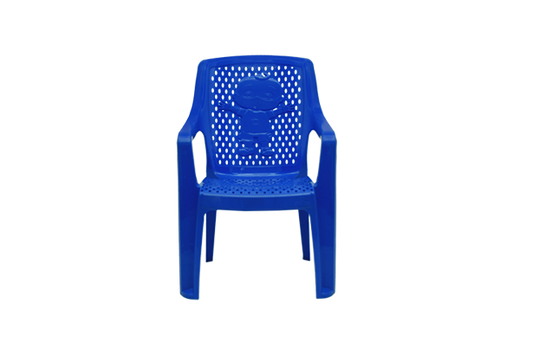
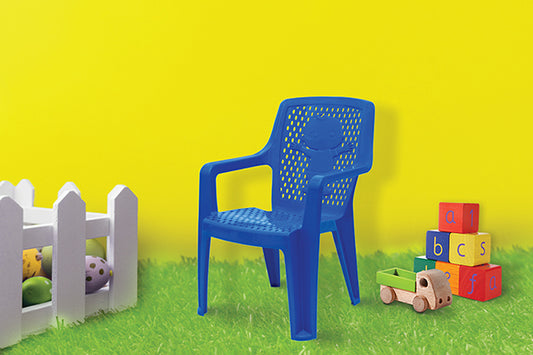
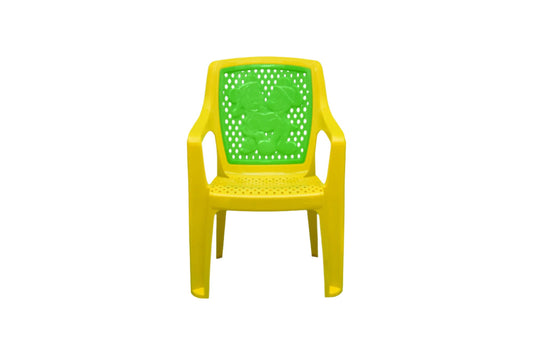
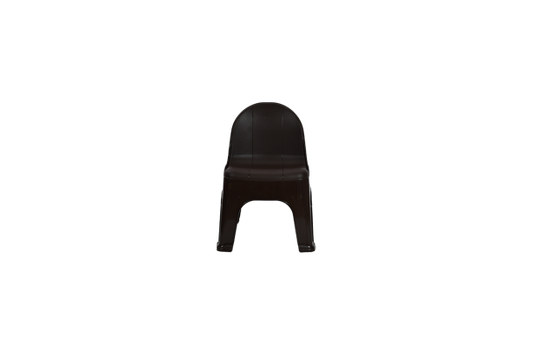
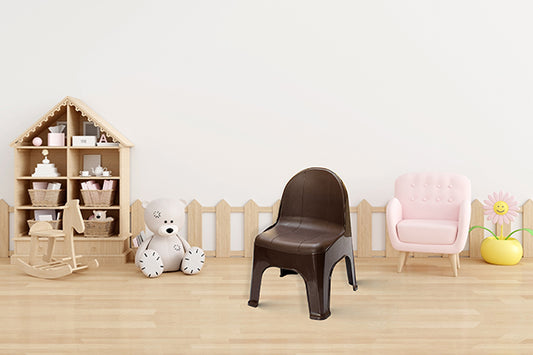
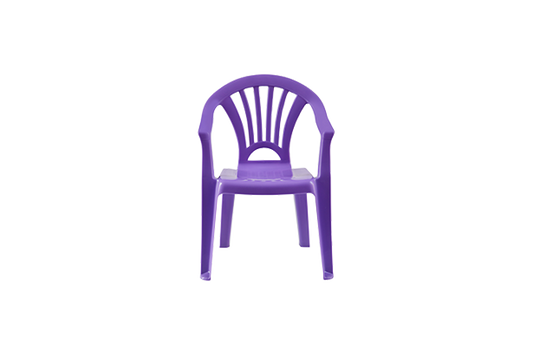
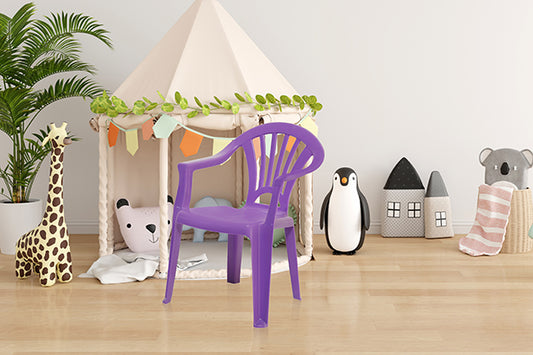
Key features to look for at this age: animal-themed or character designs that engage the child positively with their seating, smooth rounded surfaces with absolutely no sharp edges, lightweight construction (under 2 kg) so the child can move the chair independently without risk of dropping it, and bright primary colours that support the visual environment of early childhood spaces.
A toddler chair placed at a matched-height table (table height approximately 42–45 cm) creates the correct proportional relationship - elbows just above table level, feet flat on the floor, back in contact with the chair backrest.
Early Primary School: Ages 5 to 7 (height approximately 105–125 cm)
Appropriate seat height: 30–34 cm from floor to seat Appropriate seat depth: 28–32 cm Backrest height: 34–40 cm from seat
This age group begins sustained sitting for the first time - homework sessions, reading, structured study - and the ergonomic requirements shift significantly. Back support that covers the lower and mid-back is now important. The backrest should be tall enough to support the thoracic spine as well as the lumbar zone, since children at this age do not yet have the core strength to maintain upright posture without backrest contact for extended periods.
Seat depth is the most commonly mis-specified dimension for this age group. Too deep a seat - common when parents buy "slightly large" chairs with the intention of the child growing into them - prevents full back contact with the backrest because the child's legs are not long enough to reach the front edge. The child ends up perching forward, eliminating all back support. Buy the chair that fits now, not the one that will fit in two years.
The Italica Kids World Series includes chair designs for this age range with appropriately calibrated seat depths and backrests that provide genuine mid-back support for early primary school sitting sessions.
Upper Primary School: Ages 8 to 11 (height approximately 125–145 cm)
Appropriate seat height: 34–38 cm from floor to seat Appropriate seat depth: 32–36 cm Backrest height: 40–48 cm from seat
This is the age group with the highest daily sitting burden in the Indian context. School hours of six to seven hours plus coaching class time plus home study adds up to nine to eleven hours of sitting for many children in this bracket - a sustained postural load equivalent to what an adult professional experiences at a desk job.
The key study set consideration at this age is the chair-and-desk relationship. Italica's 5229 Kids Study Set - comprising a chair and table designed as a matched unit - is built for exactly this age band. The table height and chair seat height are calibrated to deliver the correct ergonomic angles for study work, and the chair backrest provides lumbar and mid-back support that helps maintain correct posture through extended homework and study sessions.
At this age, the backrest contouring matters as much as the height. A flat backrest gives surface contact but no spinal guidance. A contoured backrest with a gentle lumbar curve actively guides the child into correct spinal alignment rather than leaving them to find it on their own - which most children aged 8 to 11 will not do consistently without physical support.
Middle and Secondary School: Ages 12 to 16 (height approximately 145–165 cm)
Appropriate seat height: 40–45 cm from floor to seat Appropriate seat depth: 36–40 cm Backrest height: 46–55 cm from seat
By this age, children's bodies are approaching adult proportions and adult study demands - JEE and NEET preparation commonly begins at 13 to 14 years and involves six to ten hours of daily study time. A well-documented physiotherapy case review published in Kashmir Reader noted that early kyphosis and recurring upper-back pain are increasingly common in young people aged 16 to 23 - traced directly to sustained poor posture during study years beginning in early adolescence.
At this age range, parents should seriously consider whether a kids' chair remains the right product or whether an adult-specification Spine Care chair - such as Italica's 2109 model - is the more appropriate choice. A student of 14 or 15 who is sitting ten hours a day for competitive exam preparation needs the full lumbar support, correct backrest angle, and seat depth of an adult ergonomic chair, not a children's product designed for a primary school-age body.
The transition point is practical: when the child's sitting height requires a seat height above 42 cm and their body weight exceeds 60 kg, move to an adult Italica Spine Care chair rather than continuing to upsize within the kids' range.
What Is a Kids' Study Set and How Is It Different From a Separate Table and Chair?
A kids' study set - such as Italica's 5229 model - is a table and chair designed and manufactured as a matched pair, with dimensions calibrated specifically to deliver the correct ergonomic relationship for the target age group.
The critical advantage of a matched study set over a separately purchased table and chair is dimension accuracy. When a table and chair are designed independently and combined by a buyer, the chair seat height may be correct for the child but the table height wrong, or vice versa. The ergonomic requirements for correct study posture - particularly the elbow angle at the table surface and the backrest-to-seat geometry - only work when the table height and seat height are calibrated together.
Italica's 5229 Kids Study Set is designed as a matched unit for the upper primary school age band, with:
-
A chair seat height calibrated for this age group's leg length
-
A table height that delivers the correct elbow angle when the child is seated in the matched chair
-
A chair backrest height providing lumbar and mid-back support for extended study sessions
-
A table surface area adequate for textbooks, notebooks, and a study lamp alongside each other without crowding
For parents setting up a dedicated study corner for a primary or upper primary school child, a matched study set is the most reliable way to ensure correct ergonomics without requiring technical knowledge of furniture dimensions and their interactions.
How Do You Set Up a Study Corner Correctly for an Indian Child?
Buying the right chair and study set is step one. Setting it up correctly delivers the full ergonomic benefit.
Verify the foot-floor contact first. Seat your child in the chair in their natural position. Both feet should rest flat on the floor with the knee at approximately 90 degrees. If the feet do not reach the floor, add a firm footrest - a low stool or a flat platform - at the correct height. Dangling feet are one of the most common and most damaging posture errors in children's home study setups.
Position the study table at the correct height. When the child is seated correctly with feet flat and knees at 90 degrees, the table surface should be at approximately elbow height - the distance between the seat surface and the table top should allow the child's forearms to rest on the table with the elbows at 90 degrees and the shoulders relaxed downward, not raised.
Set up the study material at eye level. Books held flat on a table force the head into a forward-bent position - exactly the posture that causes the neck and upper back pain increasingly seen in Indian school children. A book stand or tablet holder that brings the reading surface to a 45-degree angle or higher significantly reduces cervical load during study sessions.
Ensure adequate lighting from the correct direction. Poor lighting causes children to lean forward toward their work, creating postural strain. A study lamp positioned to the left of right-handed children (and to the right for left-handed children) illuminates the work surface without creating shadows across the writing hand.
Schedule movement breaks every 45 minutes. No chair design, however well-specified, eliminates the physiological need for movement. Children should stand, stretch, and move briefly every 45 minutes during study sessions. Setting a timer makes this routine rather than a negotiated request.
What Colours and Designs Are Best for a Children's Study Space?
This is genuinely a developmental consideration, not just a preference question. Research on children's learning environments consistently shows that colour and visual environment affect mood, focus, and engagement during study.
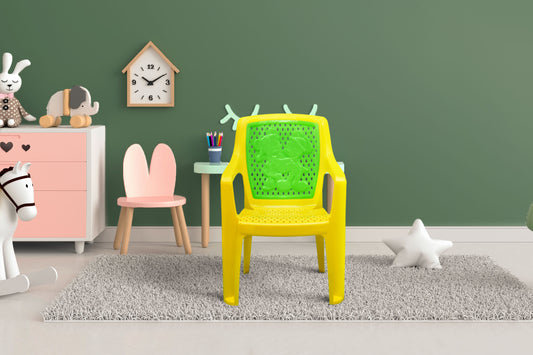
For toddler and early primary school spaces - ages 2 to 7 - bright primary colours (red, blue, yellow, green) are developmentally appropriate. They stimulate visual engagement, support the imaginative play that is the primary cognitive activity at this stage, and make the child positively associated with their seating and play space.
For upper primary and secondary study spaces - ages 8 and above - the evidence shifts. Calmer, more saturated or muted colours - teal, forest green, deep blue, warm grey - are associated with better sustained concentration than highly stimulating primary colours. A study corner designed for a 10-year-old sitting through two hours of homework benefits from a less visually stimulating environment than a play space for a 5-year-old.
Italica's Kids World Series is available across a range of colour options, allowing parents to choose age-appropriate combinations - vibrant for playrooms and younger children's spaces, more composed for older children's study environments.
Plastic vs Wood vs Metal for Kids' Chairs: Which Is the Right Choice for Indian Homes?
|
Feature |
Virgin plastic (PP) |
Solid wood |
Metal |
|
Safety (rounded edges) |
Excellent (moulded smooth) |
Moderate (requires finishing) |
Poor (sharp edges common) |
|
Weight for child handling |
Excellent (very light) |
Poor (heavy) |
Moderate |
|
Moisture and spill resistance |
Excellent |
Moderate |
Good |
|
Cleaning ease |
Excellent (wipe-clean) |
Moderate |
Good |
|
Termite risk |
None |
Present |
None |
|
Age-appropriate sizing |
Excellent (designed ranges) |
Limited |
Limited |
|
Suitable for Indian climate |
Excellent |
Moderate |
Moderate |
|
Typical lifespan |
6–10 years |
10–15 years |
5–8 years |
For Indian children's chairs, virgin polypropylene plastic is the clear recommendation across all dimensions that matter for this specific product category. The combination of rounded moulded safety, lightweight handling for child independence, wipe-clean surfaces for the inevitable spills and art project residue, and climate resilience across India's varied environments makes it the most comprehensively suitable material.
Italica's Kids World Series uses virgin polypropylene throughout - the same material commitment that delivers adult chair durability, applied to children's product specifications.
Conclusion
A correctly sized chair is not a comfort purchase for a child - it is a health investment. Children who study and play in correctly proportioned seating develop healthier postural habits, experience less musculoskeletal discomfort during their school years, and carry those habits into adulthood. Children sitting in adult chairs or ill-fitting furniture develop compensatory postures that take years to correct and, in many cases, cause lasting spinal changes.
The age-wise framework in this guide gives you the right seat height, seat depth, and backrest specification for every stage from toddler play chairs to secondary school study furniture. Italica's Kids World Series - designed for Indian children with age-appropriate dimensions, child-safe virgin polypropylene materials, rounded-edge safety moulding, and matched study sets including the 5229 Kids Study Set - provides the right product at each stage. Explore the full Kids World collection at italica.com to find the right chair for your child's age, height, and study requirements.
Frequently Asked Questions
Q: What is the right chair height for a child's study table in India?
A: The correct seat height for a child's study chair depends on the child's height and leg length, not their age alone. The seat height should allow both feet to rest flat on the floor with knees at approximately 90 degrees. For children aged 5 to 7, this is typically 30 to 34 cm; for ages 8 to 11, approximately 34 to 38 cm; and for ages 12 and above, 40 to 45 cm. The table height should then be set so the child's forearms rest at desk level with elbows at 90 degrees and shoulders relaxed.
Q: At what age should a child switch from a kids' chair to an adult study chair?
A: The transition from a children's chair to an adult ergonomic chair is determined by body size, not age alone. When a child's correct seat height exceeds 42 cm and their weight exceeds approximately 60 kg, most adult chairs - including Italica's Spine Care Series - will fit their body proportions better than a children's product. For Indian children in competitive exam preparation (JEE, NEET, UPSC foundation), this transition often occurs between 13 and 15 years given the extreme daily sitting hours involved.
Q: Is a kids' study set better than buying a separate table and chair? A: A matched study set - where the table and chair are designed and manufactured together - ensures the correct ergonomic relationship between seat height and table height for the target age group. When table and chair are purchased separately, the dimensional relationship is rarely correct, leading to the same posture problems that come from adult furniture mismatch. Italica's 5229 Kids Study Set is designed as a matched unit for upper primary school children, calibrated to deliver correct study posture for this age band.
Q: What makes a plastic chair safe for children in India?
A: A child-safe plastic chair should be made from non-toxic virgin polypropylene free from BPA, phthalates, and lead-based colourants. All edges - including the underside of the seat, backs of the legs, and the top edge of the backrest - must be fully rounded with no sharp mould parting lines. The chair must be stable under dynamic movement and ideally have rubber or anti-slip pads on the feet to prevent sliding on Indian tile and marble floors. Italica's Kids World Series is manufactured to these specifications.
Q: How do I know if my child's chair is causing posture problems?
A: Signs that a chair is the wrong size or type for your child include: the child consistently perches on the front edge of the seat rather than sitting back; feet dangle without floor contact; the child's shoulders hunch upward toward the ears when writing; the child complains of back, neck, or shoulder ache after study sessions; or the child fidgets and changes position constantly during study. All of these patterns indicate furniture mismatch. Verify the seat height first - feet must be flat on the floor - then check the table height and backrest contact.